.png)


Interview with Ali Cherri, The Sentinel director
by Grégory Coutaut
by Grégory Coutaut
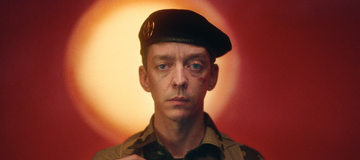
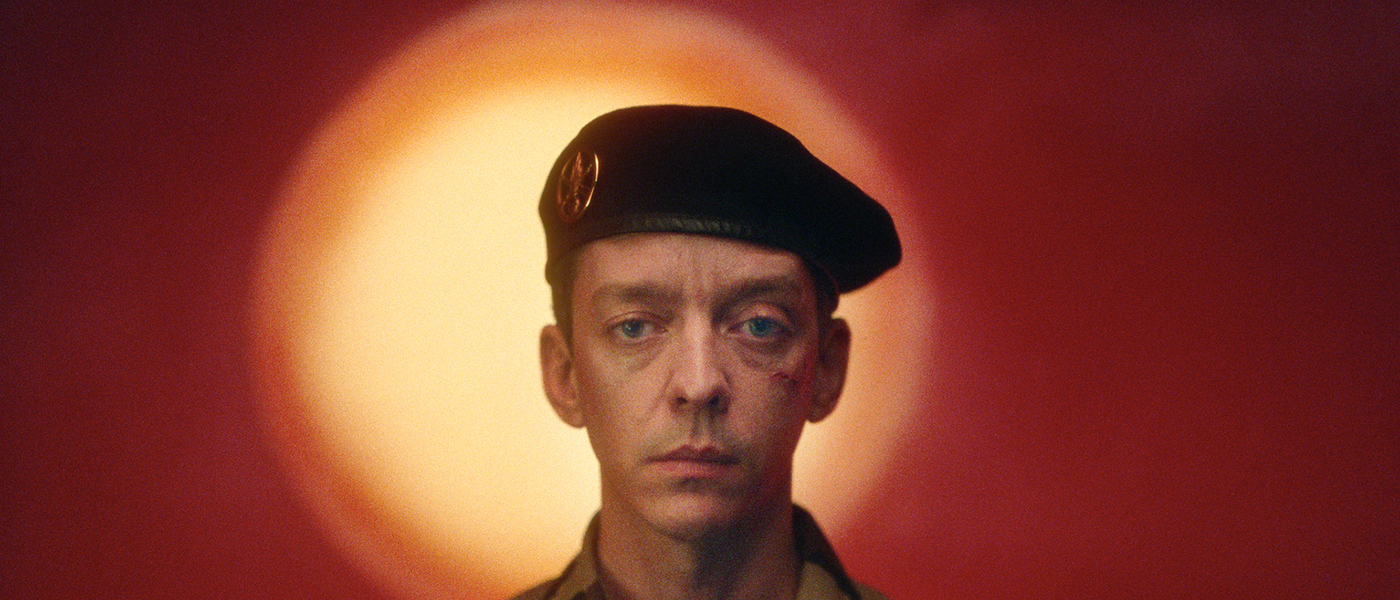
A soldier looks straight into our eyes, but his gaze is almost vacant, as if his body no longer belonged to him. In a country that is never named, in a barracks he perceives only as a series of models too small for him, he searches for a way out, however radical it may be. Through a series of stunning tableaux, Franco-Lebanese artist Ali Cherri crafts a weightless mental landscape in which the military madness of our contemporary world is mirrored against the warm convergence of two bodies - brought to life by an unexpected duo: Nahuel Pérez Biscayart and Éric Cantona.
Interview with Ali Cherri
A soldier searching for his place in the world
The soldier has once again become a central figure in the political imagination, as we hear talk of rearmament and preparation for war, in a world in which citizens’ bodies are once again mobilised, disciplined, and made available. What I’m interested in are soldiers who don’t conform to expectations. They’re tired, fragile, and sometimes falter. Their bodies resist, but almost in spite of themselves. Here, the idea of escape is radical, yet it remains ambiguous. The final gesture can be read as a decisive break, but also as turning inward. Ultimately, he might just be aiming for the soldier within.
Scale models, a deliberate artifice
The film embraces fiction, and even lays it bare. The sets are built, at times visibly so – almost fragile. We are far from any attempt to reproduce reality; from the outset, the film asserts itself as a representation. The perceptibility of the artifice creates instability. You no longer know what scale you are on, nor exactly what space you are in. And that echoes the character’s own state, he is himself in-between: between awake and asleep, between mental projection and lived experience.
A tender interlude in a violent world
I didn’t want to make a film that was only harsh, even if the world I depict very much is. Today's reality is violent, bodies are caught in patterns of domination, discipline, and war. What interests me is that, even within this harshness, moments of tenderness can emerge, however fleetingly. A gesture, a glance, a word. I find that even harshness can be permeated by something tender, and what matters to me is this coexistence. Perhaps that’s what we have left today: despite everything, bringing forms of gentleness in an increasingly harsh world. The cabaret becomes an underground refuge where tired, broken bodies that can’t find their place elsewhere come together. It’s not just a performance venue, it’s a space where another kind of presence is forged, another way of being in the world.
An unlikely duo of actors
The starting point was really the body. I wanted an almost sculptural relationship between two bodies: that of the soldier – fragile, fractured, almost slight, with a wide-open gaze – and that of the doctor, massive, able to contain him, constrain him, almost crush him. Nahuel Pérez Biscayart and Éric Cantona were the obvious choices for that tension. But there was something else: their presence in the world. I didn’t want “neutral” actors. I wanted the audience to see familiar faces that carry a story, a political position. They appear in the film with what they bring from their lives. There’s something of a shift: they’re not actors who disappear into their roles, they are real bodies inhabiting characters.
At La Semaine de La Critique