
.png)



Interview with Marine Atlan, La Gradiva director
by Marilou Duponchel
by Marilou Duponchel
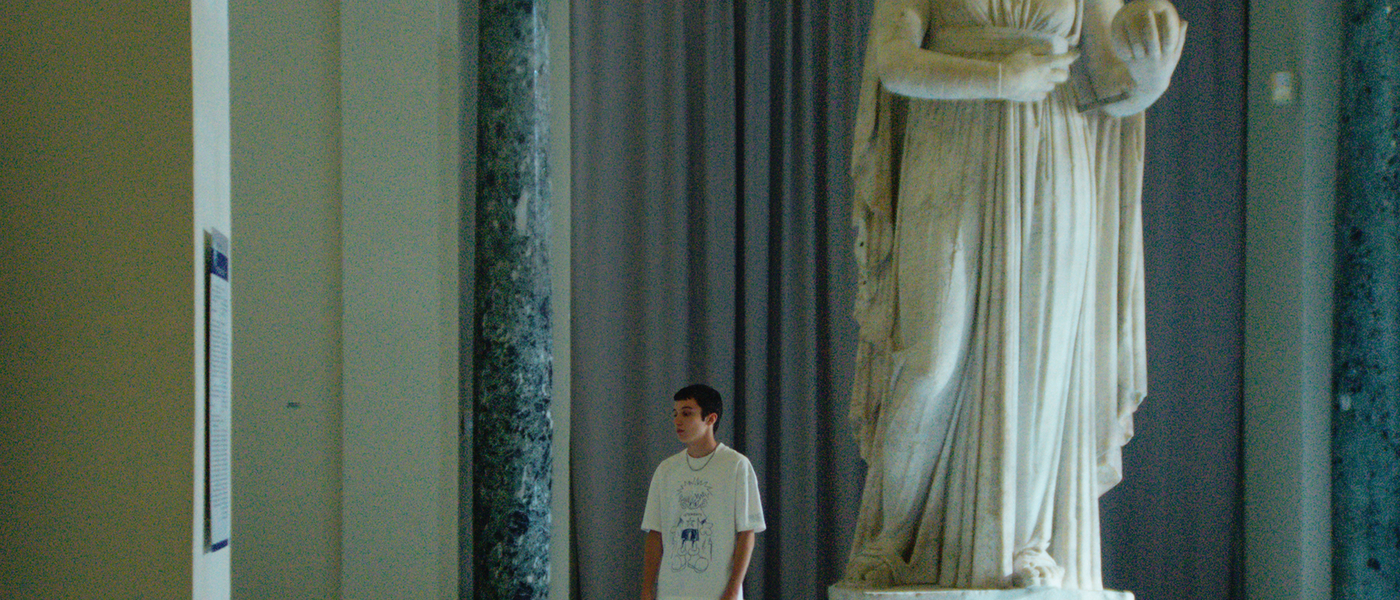
A coming-of-age story where passions and fears set the hearts of a group of French high-school students on a school trip to Pompeii racing. Known for her meticulous work as a cinematographer (Summer Scars, The Rapture, Queens of Drama, Girl in the Snow), in this film, Marine Atlan reveals herself to be an outstanding director and storyteller. Every frame exudes the hazy emotions of a disillusioned generation.
Interview with Marien Atlan
What happens when the immediacy of youth and the eternity of ruins collide? I had the feeling that this held strong dramatic and aesthetic potentialI was thinking of Arte’s series “All the Boys and Girls of their Time” – something made quite quickly, with a group of non-professional actors and actresses. The challenge was then to direct twenty young actors and actresses to accurately capture the dynamics of the group – we prepared extensively from writing the script, through casting to rehearsals.
We had to convey the different representations within the group in order to make a film about adolescence. I often thought of the feeling I had while reading the poem Romance by Arthur Rimbaud and its famous line: “we aren’t serious when we’re seventeen.” To take seriously something that isn’t: what is it that is so fleeting and yet endlessly repeated in youths across generations?
When I went to Pompeii, I felt the poetic potency of this place, which maintains a very concrete relation with death – something that obviously and paradoxically produces a powerful sense of vitality. It’s not just Pompeii; it’s Southern Italy as a whole, a festive, family-oriented region with its connection to rites and beliefs.
Naples is a very difficult city to film because it is dense and complex; it’s a city of layers, where all eras can be seen. I felt dizzy at the idea of having to grasp and understand it. Taking stock of the challenges, I opted for a documentary approach that resonated with the story of Toni, the protagonist: observing to try to understand what exile takes away. In that sense, my perspective as a foreigner directly aligned with the narrative.
Because my first intuition was to tell the story of an uprooted character who realises he is the victim of social determinism and is thrown off by an inheritance – running counter to traditional narratives of social mobility. I wanted to show how social destiny intertwines with chance, how determinism is sealed by contingencies and takes on a tragic dimension. As the characters descend further into tragedy, the film itself transforms. It slows down, increasingly embracing its stylistic effects – colours, music - and reaches lyricism before it shifts to a melodrama.
The title is taken from a short story by Wilhelm Jensen, which tells of an archeologist’s obsession with a bas-relief depicting a walking woman (Gradiva, in latin). He imagines her as a Pompeian woman and pursues this fantasy into the ruins buried by the eruption of Mount Vesuvius. I discovered it through Freud, who studied this text as part of his work on the interpretation of dreams. For him, Pompeii becomes a territory conducive to representing the unconscious.
This mythological figure called for fantasy and movement – with movement itself becoming an allegory for destiny. I liked these latin and mysterious sounds and they stood as a counterpoint for the realistic tone of the film.
At La Semaine de La Critique