.png)


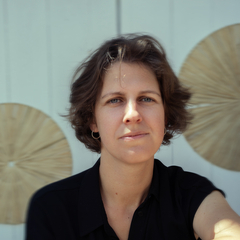
Interview with Anne-Sophie Girault, Visit into irradiated land director
by Esther Brejon
by Esther Brejon
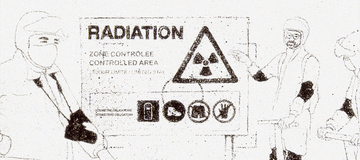
Little black and white dots come to life, vibrate, and move with a single purpose: to make the invisible visible. Inspired by the events of Chernobyl and Fukushima, Anne-Sophie Girault imagines the consequences of a nuclear accident in France through a guided tour of an area contaminated by radioactivity. In a film as scary as it is realistic, she subverts the conventions of disaster films to observe, without passing judgement, a new kind of tourism.
Interview with Anne-Sophie Girault
What technique did you use in Visit into Irradiated Land?
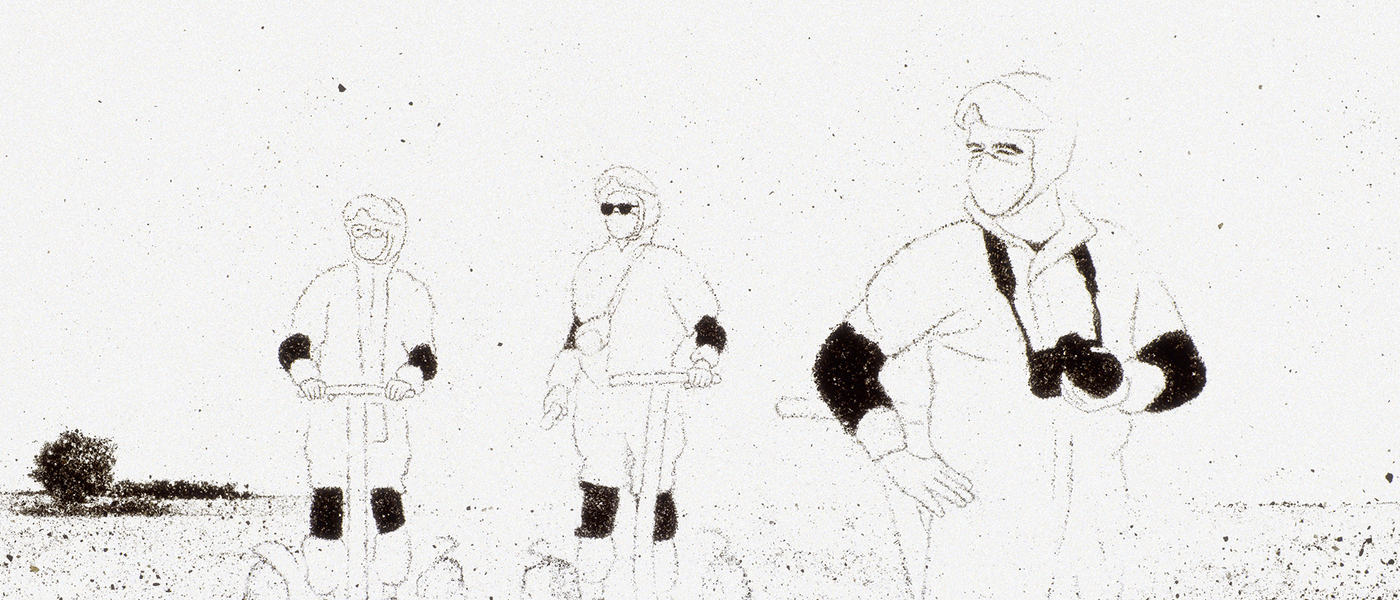
I used animated soil on a backlit glass surface, above which a camera is placed. I draw with grains of soil on the glass, using brushes, my fingers, and various tools. The idea is to create the first drawing, take a picture, move the soil, take another picture, move the soil yet again, and so on – for two years! What I love above all are the material and the technique: the simplicity of the process, the pared-down aesthetic that emanates from it due to its near-monochrome palette. The connection with touch as well, of moving material that is never still. The soil is one of the major stakes of decontaminating an area after a nuclear incident, so it made sense for me to use this material. By setting the grains in motion, the whole image starts to quiver. I see it as a glimpse at radioactivity, swarming, spreading everywhere. A way to make the invisible visible and hint at a pervasive threat.
What were your sources of inspiration when writing the script?
It was an extensive and ongoing research process. I read a great deal about Fukushima and Chernobyl. With my collaborator Céline Samperez-Bedos, we travelled to Chernobyl and went on several guided tours of the area. Going there enabled us to fully grasp the complexity of the issue, caught between the desire to raise awareness and an interest in showing the touristic dimension of these visits.
The film is very realistic. How did you manage to make it so lifelike?
That was something I was really aiming for, to make it feel real. That’s why we worked with the Golfech nuclear plant. I was looking for a tour that could actually exist. Beaumont-de-Lomagne and Coutures are villages about 30 kilometres from Golfech. With Céline Samperez-Bedos, we made many trips back and forth to the region to take pictures, videos, and to get a feel for the area. Then there was rotoscoping, using pictures and videos we had taken here and there. What’s great about animation is that you can take a bunch of random pictures and use them as a foundation for your drawings. In the film, there’s footage of friends riding Segways, a visit to a local farm, realistic pictures of the region, as well as footage from Chernobyl and archive material from Fukushima, including that of nuclear waste and decontamination processes.
At La Semaine de La Critique